
admin 30 Jun 2026
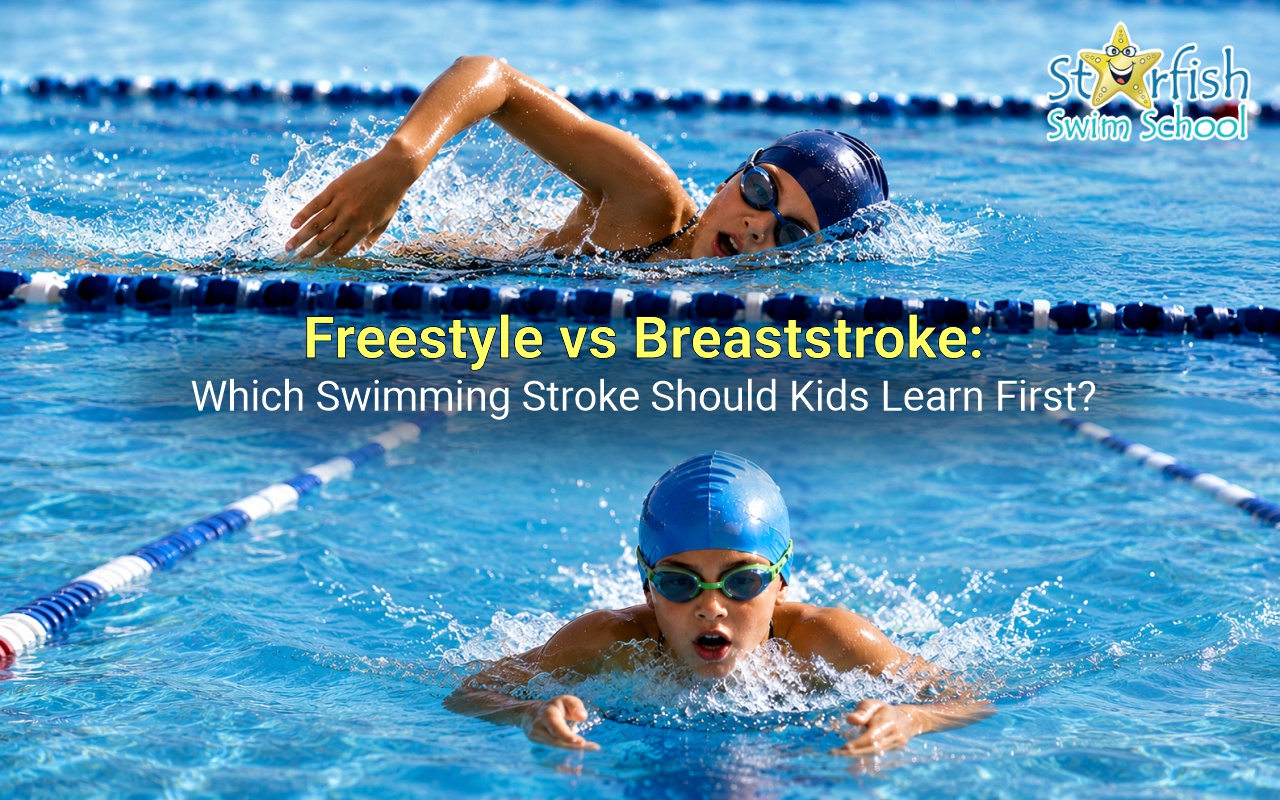
Freestyle swimming should be the first stroke you learn. Once you have mastered the freestyle stroke, you will feel more comfortable and secure in the water. While both freestyle and breaststrokes have their own unique and impactful developmental advantages, freestyle is the most appropriate beginning swimming stroke. Freestyle has a stable repetitive motion, making it easier for young swimmers to learn right from the beginning.
The environment you create for your child’s introduction to water safety will greatly impact the long-term relationship your child will develop with the pool. At Starfish Swim School, we have designed our learn to swim curriculum based on a natural progression through beginner swimming lessons. This blog post will highlight the progression of swimming lessons as it relates to freestyle versus breaststroke for children.
Freestyle swimming is a non-stop stroke that involves alternate kicking and arm movement through the water. By developing a repetitive motion in swimming, young children can maintain forward movement and stay high in the water with buoyancy. While developing cardiac fitness, core strength will also be improved.
The primary purpose of beginner swim lessons for children is to learn how to move through the water safely and effectively.
Here is why freestyle is the best swimming stroke for beginners and is given priority:
The most difficult aspect of the freestyle stroke is the skill of side breathing. Breathing while facing down in the water and not raising your chest takes practice and body awareness. Although the body roll will help with swimming posture, the importance of learning the body roll as an early learner will also create a strong foundation for swimming successfully in all styles.
Breaststroke, in general, appears to be an easy, gentle stroke choice. When viewing the stroke, the head is raised vertically out of the water so children can see the instructor. However, the actual stroke mechanics are different.
Breaststroke has a very technical, broken rhythm that is typically synchronised in the pattern pull, breathe, kick, and glide (as opposed to freestyle, in which everything is done at once). The "whip" kick requires a certain angle of the feet and outside rotation of the ankles, both of which are physically difficult for toddlers or younger children and can cause structural confusion.
A child who misjudges their timing (like kicking when pulling) will completely lose their momentum and therefore sink completely; due to these high coordination requirements, breaststroke is usually taught later in the progression than other strokes.
| Metric / Feature | Freestyle | Breaststroke |
|---|---|---|
| Primary Kick | Flutter kick (up and down) | Whip kick (circular, outward snap) |
| Body Position | Flat, streamlined, rolling | Flat to inclined, undulating |
| Coordination Type | Alternating, continuous | Simultaneous, sequential |
| Safety Application | Fast, efficient distance coverage | Energy conservation and visibility |
In Australia, the ultimate goal of a learn to swim program is always safety in and around the water. Freestyle and breaststroke both provide children with the skills to keep them safe in the water in very different ways.
Freestyle is the fastest method of swimming, which means that if your child falls into a pool by accident, they will have the mechanical speed to return to the edge of the pool quickly.
Breaststroke provides an extraordinary method of swimming that can be performed with your head above water (swimming slowly), conserving your energy, looking for assistance, and navigating through rougher water without experiencing panic.
Each child's swim journey is unique, starting from Early Infant Aquatics through to the correction of their stroke technique. Teaching children strokes in the order in which they naturally develop will help to limit frustration from more complex swimming strokes before they have the confidence to swim in the water.
If you're looking for children's swimming lessons in Melbourne, the Starfish Swim School team is here to assist you to learn freestyle and breaststroke techniques. We conduct small group classes based on development milestones and private swim lessons for individual one-on-one swim instruction.
Your child will develop swimming confidence for life. For more information about the Starfish Swim School programme and for details on finding the right class for your family, please call us today!

 10 Clapperton Street, Bentleigh 3204